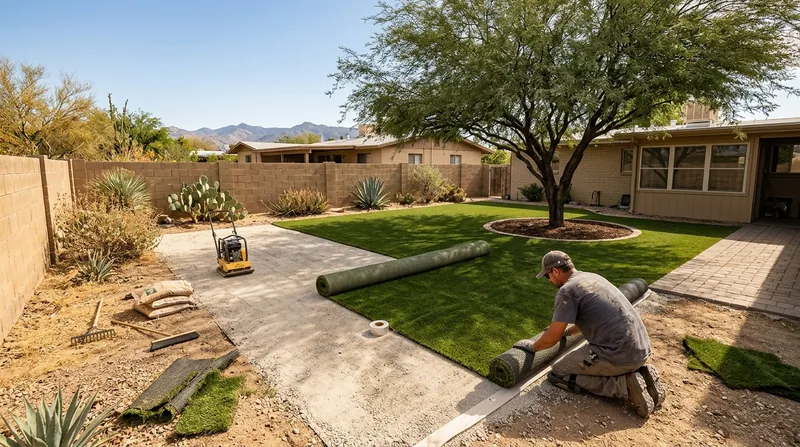




Residential Artificial Grass Installation in Tucson transforms desert yards into year-round green spaces without the water demand of living turf. Tucson's climate, terrain, and architectural character create unique conditions for artificial grass: intense summer heat well over 100 degrees, monsoon downpours from July through September, rocky caliche-laden soil, and neighborhoods ranging from historic adobe row houses in Barrio Viejo to 1950s slump-block ranches in midtown to stucco Santa Fe homes in the Catalina Foothills. Most Tucson yards start with dormant Bermuda grass, decomposed-granite beds, or bare ground ringed by tan block walls. We install turf that holds up to that heat, drains properly through monsoon rains, and works with your home's architectural style and HOA rules. Since 2013, we've specified every installation by product name, face weight, pile height, infill type, and base depth in writing, so you know exactly what you're getting.
Why Residential Artificial Grass Installation Matters in Tucson's Desert Climate
Tucson's summer temperatures and monsoon cycles put real grass under constant stress. Winter dormancy leaves yards straw-colored for months, and the region's low annual rainfall means a living lawn demands heavy irrigation or dies back. Artificial turf eliminates that cycle entirely. You get a green yard year-round without watering during peak heat, without the brown-out months, and without the maintenance grind of mowing, fertilizing, and pest control in a climate where heat and hard caliche make lawn care a losing battle.
- Eliminates the need for regular watering during Tucson's 100-plus-degree summers and the winter dormancy cycle.
- Drains properly through monsoon downpours so your yard does not turn into mud or pond.
- Stays green and usable year-round, unlike Bermuda grass that goes dormant and pale from October through March.
- Reduces the physical and financial burden of mowing, fertilizing, and pest treatment in desert heat.
- Works with Tucson's HOA rules, which often govern front-yard turf color, pile height, and edging.
In Tucson, artificial grass is not a luxury but a practical solution to a climate that works against living turf.
Key info: Tucson's monsoon season (July through September) brings sudden heavy rains and dust storms. Proper base preparation and drainage are critical to prevent water pooling, turf flotation, and seam separation. We build a solid base and slope every yard to shed water quickly.
For more context on water conservation and landscape alternatives, see City of Tucson Water Department resources.
How We Install Residential Artificial Grass in Tucson: Our Step-by-Step Process
Every installation begins with an on-site visit to assess soil, drainage, shade, and your home's footprint. We request an Arizona 811 utility locate to identify underground electric, gas, and water lines before we break ground. Then we remove existing grass or debris, grade and compact the base, lay a drainage underlay, and seam the turf with precision. We name the product, face weight, infill, and base depth in writing before we start, so there are no surprises.
- Visit your yard to assess drainage, shade, HOA rules, and existing conditions like gravel, decomposed granite, or dormant Bermuda grass.
- Request an Arizona 811 utility locate to mark underground lines before excavation.
- Remove existing turf, debris, and high spots; identify and correct any drainage problems.
- Grade and compact the subgrade to proper slope for water runoff.
- Lay a drainage underlay or recycled-asphalt base to specification.
- Roll, cut, and seam the turf using a professional heat welder for permanent, invisible seams.
- Infill with the specified material (recycled rubber, zeolite, or engineered pellets) and brush the pile upright.
- Walk the entire yard to confirm seams are solid, pile is even, and drainage works as designed.
The entire process typically takes 2 to 4 days, depending on yard size and site conditions.
Example: A 600-square-foot backyard in Tucson with existing Bermuda grass, a sloped grade, and one mature palo verde tree takes about 3 days. We remove the old grass, build a 4-inch compacted base, lay the turf, infill it, and edge it with metal or plastic. The result is a low-maintenance yard that handles monsoon rain and 120-degree heat without degrading or pooling.
Learn more about our pet-friendly turf options if you have dogs or want reinforced drainage for high-traffic areas.
Installation Approaches: Base Preparation and Product Selection
| Approach | Description | Best for |
|---|---|---|
| Recycled-Asphalt Base | Compacted recycled asphalt with drainage underlay, 4 to 6 inches deep, sloped for runoff. | Most Tucson yards with native soil or existing turf; excellent drainage in monsoon season. |
| Permeable Concrete or Paver Base | Turf laid over permeable pavers or lightweight concrete with an underlay system. | Patios, pool decks, and areas where a solid walking surface is required beneath the turf. |
| Direct-Lay on Existing Hardscape | Underlay and turf applied directly to concrete, asphalt, or existing slabs with proper slope. | Balconies, rooftops, and small patios where excavation is not an option. |
| Sloped or Tiered Installation | Custom grading to handle elevation changes, terracing, or steep slopes with reinforced edging. | Hillside yards in the Catalina Foothills, Oro Valley, or other sloped terrain. |
Each approach is chosen based on your yard's existing conditions, drainage challenges, and intended use. We always prioritize water management because Tucson's monsoon rains and summer heat demand a system that sheds water quickly and holds up under UV exposure.
Residential Artificial Grass Installation Cost in Tucson: What to Expect
Artificial turf installation in Tucson typically starts at around $8 per square foot, though the final cost depends on several site-specific factors. A 600-square-foot backyard might run $4,800 to $6,000, while a 1,000-square-foot installation could range from $8,000 to $12,000 or more. The price moves up or down based on existing conditions, base depth, infill type, and the complexity of drainage or grading work required. Most yards in Tucson need a 4- to 6-inch compacted base, which adds cost but ensures the turf survives monsoon downpours and summer heat without pooling or shifting.
Factors that affect your final cost include the following:
- Existing ground conditions: bare soil costs less than removing old turf or breaking up compacted ground.
- Slope and drainage: yards that need significant regrading or drainage correction cost more upfront but save you from future failure.
- Shade: mature palo verde, mesquite, or saguaro trees may require custom cutting and seaming, adding labor.
- Turf product and infill: premium face weights and specialized infills (zeolite for pet areas, cooling infill) increase the per-square-foot rate.
- Base depth: a 6-inch recycled-asphalt base with underlay is more expensive than a 3-inch base but performs better in Tucson's monsoon season.
- HOA submittals: if your neighborhood requires architectural approval, we help you prepare specifications and drawings, though approval is never guaranteed.
The best way to know your actual cost is to get a free, on-site estimate. Visit our pricing page for more detailed breakdowns, and call us at (520) 214-5021 to schedule an estimate. We respond within 24 hours with no obligation to book.
Residential Artificial Grass Installation Near Me: What Tucson Homeowners Should Know When Hiring
Finding the right turf installation company matters because poor work shows quickly in Tucson's heat and monsoon rains. Seams can separate, turf can shift, and drainage problems cause pooling and mold. When you are comparing installers in Tucson, Oro Valley, Marana, Sahuarita, or the Catalina Foothills, look for these concrete signs of professionalism and care.
- Request a certificate of insurance naming general liability and workers' compensation coverage.
- Ask for a written specification that names the turf product, face weight in ounces per square yard, pile height, infill type and pounds per square foot, base material, and base depth.
- Check references and ask to see photos of finished installations in similar Tucson neighborhoods.
- Confirm that the company has a local address and is reachable by phone during business hours.
- If your HOA requires architectural approval, verify that the installer will help you prepare and submit specifications to your HOA board.
- Ask whether the company handles Arizona 811 utility locates and what happens if a private line (irrigation, low-voltage lighting, pet fence) is damaged.
- Get at least two or three estimates so you can compare scope, materials, and price.
A professional turf installer will answer every question in writing and never rush you into a contract. We're fully insured and have been serving Tucson since 2013. Call us for a free estimate at (520) 214-5021, and we'll walk you through every step of the process.
Residential Artificial Grass Installation in Tucson: Pricing Guide
| Service | Price | Details |
|---|---|---|
| Residential yard, 400-600 sq ft | Starting at $8/sq ft | Includes base prep, recycled-asphalt compacted base, underlay, turf, seaming, and infill for a typical Tucson backyard |
| Residential yard, 1,000+ sq ft | Starting at $8/sq ft | Larger yards may qualify for slight per-square-foot savings; final price depends on drainage, grading, and site access |
| Specialty base or drainage correction | On estimate | Yards with caliche, poor drainage, or monsoon pooling issues need site assessment before pricing |
| Travel and site visit | Included | No mileage fee or call-out charge within Tucson and surrounding areas including Oro Valley, Marana, and Sahuarita |
| Free estimate | Free | On-site measurement and specification review with response within 24 hours, no obligation to proceed |
Indicative pricing, the exact cost depends on square footage, finish, and site access. Free personalized estimate within 24h at (520) 214-5021.


